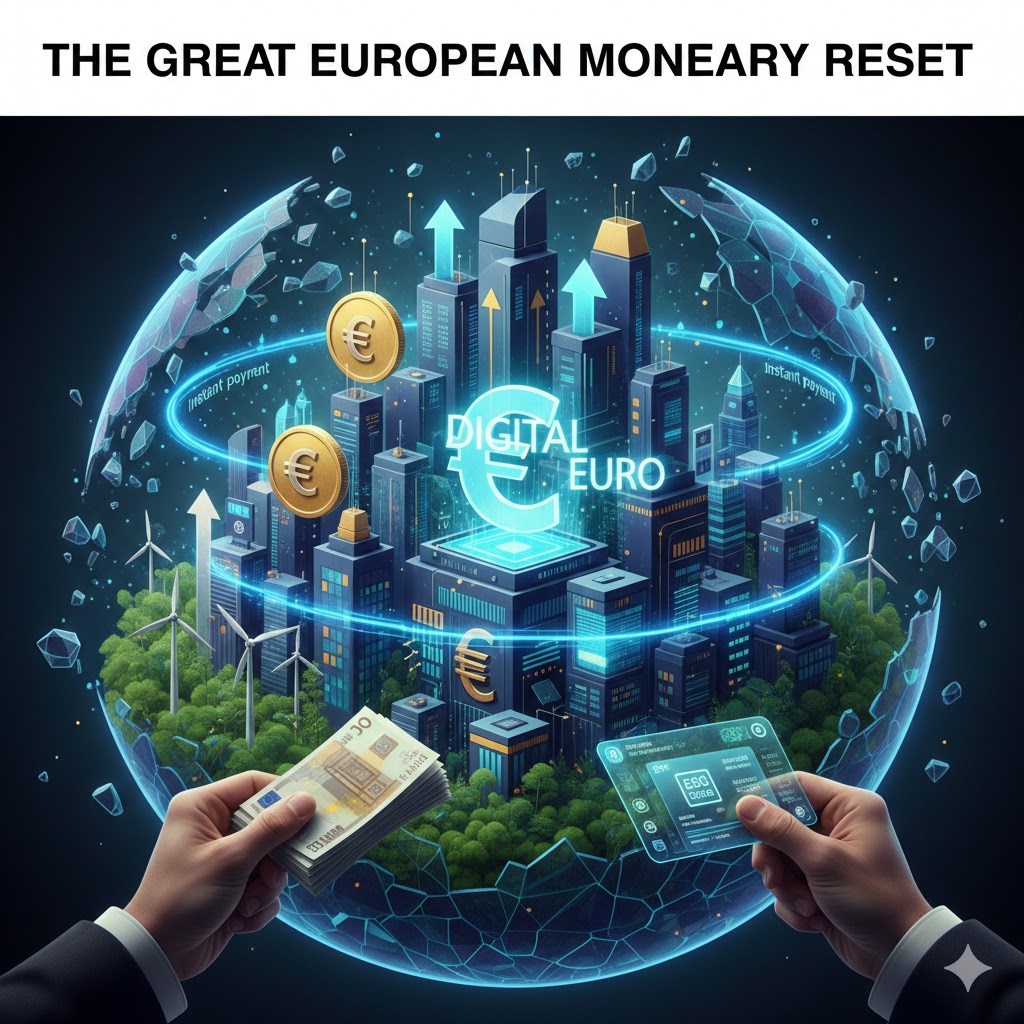
The European Union is at the precipice of its most profound financial transformation since the introduction of the euro banknotes and coins over two decades ago. This shift is not merely an upgrade; it is a fundamental re-engineering of the entire monetary and financial ecosystem, driven by a trifecta of forces: digitalization, regulation, and sustainability.
For businesses, investors, and consumers alike, understanding this “Great European Monetary Reset” is paramount. The changes—from a central bank digital currency (CBDC) to instant payment mandates and radical sustainability disclosure rules—will redefine how we transact, invest, and manage wealth across the continent. This is the definitive guide to Europe’s future of money, a journey into the heart of modern finance and the policies shaping a digitally sovereign and green economy.
I. The Digital Euro Revolution: CBDC as the New Monetary Anchor
The most ambitious component of Europe’s financial future is the potential launch of the Digital Euro.
Shutterstock
Explore
This project by the European Central Bank (ECB) is not just a technological experiment; it is a defensive and strategic move to safeguard monetary sovereignty in an increasingly digital and geopolitically fragmented world.
A. Why Europe Needs a Digital Euro
The modern economy has largely shifted from physical cash to private digital money—deposits held at commercial banks or payments processed by a handful of global card schemes (like Visa and Mastercard). This shift creates two key vulnerabilities that the Digital Euro aims to address:
- Risk and Trust: Private commercial bank money carries a small, theoretical risk (which is mitigated by deposit insurance). Central bank money, however, is risk-free. As cash use declines, the public risks losing access to this risk-free form of money in the digital realm. The Digital Euro, as a CBDC, provides a safe, sovereign-backed anchor for digital payments.
- European Autonomy: The majority of non-cash payments in the Euro area rely on platforms and infrastructure originating outside the EU. This poses a threat to Europe’s financial stability and strategic autonomy. The Digital Euro is designed to be a pan-European payment solution, accessible and accepted in all euro area countries, fostering genuine competition and reducing reliance on international incumbents.
B. Project Status and Key Timelines
The Digital Euro project has moved through its exploration and investigation phases and is now firmly in the preparation phase. This phase, which includes the development of the technical foundations and the finalization of the Digital Euro Scheme Rulebook, is expected to be completed by the end of 2025.
Crucial dates and milestones for the future include:
- 2026: Expected adoption of the necessary EU legislation. This legislative backing is crucial, as it will determine the final design features, including privacy and limits on holdings.
- Mid-2027: Potential start of a pilot exercise and initial transactions with payment service providers (PSPs).
- 2029: The ECB aims to be ready for a potential first issuance.
C. Design Principles: Privacy, Offline Functionality, and Limits
The ECB has been clear that the Digital Euro must possess the benefits of cash in a digital form:
- Privacy: The Digital Euro is designed to offer the highest privacy standards, particularly for low-value transactions. The ECB and the Eurosystem would not be able to identify users or track their payments, providing a significant privacy advantage over current commercial payment methods.
- Offline Capability: To ensure continued availability, a key design feature is the ability to use the Digital Euro offline. This would allow payments to be made without an internet connection, strengthening resilience against outages and making it accessible to those with limited connectivity.
- Financial Stability: To prevent mass shifts of funds from commercial bank deposits into Digital Euro holdings—a phenomenon known as bank disintermediation—the ECB will likely impose a limit on individual holdings. This limit would ensure the Digital Euro functions as a medium of exchange (for daily payments), not a vehicle for large-scale savings.
The Digital Euro stands as Europe’s definitive commitment to having a future-proof, robust, and central bank-backed digital currency, fundamentally reshaping the definition of “money” for the 21st century.
II. The Instant Payments Mandate: Redefining Real-Time Transaction Speed
While the Digital Euro is a monetary innovation, the EU Instant Payments Regulation (IPR) is a market innovation that is transforming the daily operational flow of money right now. This regulation mandates that all payment service providers (PSPs) across the Euro area must offer real-time credit transfers—executed and settled within 10 seconds, 24 hours a day, 365 days a year.
A. Key Obligations and The 2025 Deadline
The IPR, which entered into force in April 2024, has strict, near-term deadlines for PSPs:
- January 9, 2025: Euro-area PSPs must be able to receive instant payments.
- October 9, 2025: Euro-area PSPs must be able to send instant payments.
- Equal Charges: Charges for instant credit transfers cannot be higher than those for standard, non-instant transfers. This effectively makes instant payments the new standard at no extra cost to the consumer.
B. Impact on Business and Financial Systems
The mandatory nature of SEPA Instant Credit Transfer (SCT Inst) represents a massive change for the European economy:
- Working Capital Optimization: For businesses, particularly SMEs, the elimination of multi-day settlement cycles means immediate cash flow. This significantly reduces the working capital tied up in outstanding invoices, optimizing liquidity management and reducing reliance on short-term financing.
- Fraud Prevention (Verification of Payee): The regulation also mandates the Verification of Payee (VoP) service. This crucial anti-fraud measure requires PSPs to check if the beneficiary’s name matches the provided International Bank Account Number (IBAN) before the payment is sent. By alerting the payer to mismatches, VoP is a powerful tool against Authorized Push Payment (APP) fraud, a growing problem in real-time payment systems.
- The Rise of A2A Payments: The IPR is a massive accelerator for Account-to-Account (A2A) payments. By making transfers immediate and free (or cheaply priced), A2A payment solutions—often powered by Open Banking APIs—become a highly competitive alternative to traditional card networks for e-commerce and point-of-sale transactions.
C. The European Payments Initiative (EPI)
Complementary to the IPR, the European Payments Initiative (EPI) is a consortium of major European banks and payment providers aiming to create a unified, European-owned payment scheme. EPI is designing a digital wallet solution and an accompanying payment card to compete directly with US-based card giants, leveraging the new instant payment infrastructure. The goal is clear: to ensure that the future of digital money is settled on European rails.
III. The New Regulatory Environment: MiCA, DORA, and Financial Resilience
Europe’s push to modernize money is intrinsically linked to its ambitious regulatory agenda. The EU has become a global standard-setter in governing the digital economy, particularly in the nascent fields of crypto-assets and operational resilience.
A. MiCA: Bringing Crypto-Assets into the Regulatory Fold
The Markets in Crypto-Assets Regulation (MiCA) is a landmark piece of legislation that provides a single, harmonized regulatory framework for crypto-assets across all 27 EU member states. This clarity is a game-changer for the Fintech sector and the future of digital asset trading.
- Stablecoin Regulation (June 2024): MiCA’s rules on Asset-Referenced Tokens (ARTs) and E-Money Tokens (EMTs) (colloquially known as stablecoins) are already in force. Issuers must be authorized, maintain full liquid asset backing, and comply with strict capital and reporting requirements, ensuring a level of stability and consumer protection previously absent in the sector.
- Licensing and Service Providers (December 2024 – July 2026): By December 30, 2024, the full MiCA framework, including licensing requirements for Crypto-Asset Service Providers (CASPs), becomes applicable. CASPs—such as exchanges, custodians, and brokers—must obtain authorization from a national competent authority. This creates a passporting system, allowing a CASP licensed in one EU country to operate across the entire bloc.
- Future Impact: MiCA is set to legitimize and formalize the use of crypto-assets, bolstering investor protection and attracting institutional finance to the European digital asset market. For businesses, this means regulatory certainty, which is essential for scaling blockchain-based and tokenization initiatives.
B. DORA: Securing the Digital Financial Future
The Digital Operational Resilience Act (DORA) addresses the flip side of digitalization: the risk of system-wide failure due to cyberattacks or IT disruptions. DORA creates a comprehensive set of rules to manage and mitigate ICT-related risks for financial entities, including banks, payment institutions, and even critical third-party ICT service providers (like cloud providers).
- Key Focus: DORA mandates robust cyber risk management frameworks, stringent reporting of major ICT-related incidents, and rigorous digital operational resilience testing.
- Future Reference: DORA’s implementation underscores the EU’s recognition that the future of finance is utterly dependent on the stability and security of its underlying digital infrastructure. It represents a proactive regulatory step to ensure the resilience of the system that hosts the Digital Euro and Instant Payments.
IV. The Greening of Capital: Sustainable Finance and ESG Investing
The flow of future money in Europe is being steered not just by technology, but by a legally binding commitment to environmental and social objectives. Europe has established itself as the global leader in sustainable finance, channeling capital toward the green transition to meet its Net-Zero goals.
A. The Sustainable Finance Disclosure Regulation (SFDR) Overhaul
The Sustainable Finance Disclosure Regulation (SFDR) has been the EU’s primary tool for driving transparency in the ESG investing market. However, in late 2025, the European Commission proposed significant amendments (sometimes referred to as SFDR 2.0) to address market confusion and combat greenwashing.
- The Problem: The existing SFDR disclosure requirements were complex and were being used as a de facto labelling system (with “Article 8” and “Article 9” funds), leading to confusion, particularly among retail investors.
- The Future System (SFDR 2.0): The overhaul aims to simplify the framework by introducing a new, clear, voluntary categorization system, replacing the vague disclosure tiers:
- Sustainable Products: For products pursuing a clear, high-ambition environmental or social objective.
- Transition Products: A crucial new category for products financing companies that are not yet fully sustainable but have credible transition plans to achieve alignment with climate goals (e.g., the Paris Agreement). This will help unlock capital for the heavy-polluting sectors that most need to decarbonize.
- Impact on Investment: This structural change is designed to make the sustainability of investment products clearer, simpler, and more verifiable. By deleting complex entity-level disclosures and simplifying consumer-facing templates, the EU is making it easier for retail investors to align their savings with their values, accelerating the flow of capital toward green bonds, impact investing, and other sustainable assets.
B. The EU Taxonomy and Corporate Reporting
The EU Taxonomy—a classification system for environmentally sustainable economic activities—remains the gold standard for defining what constitutes a “green” investment. When paired with the Corporate Sustainability Reporting Directive (CSRD), which mandates detailed, standardized ESG reporting from thousands of large companies, the EU is building an interconnected data highway.
This combination of rules ensures that the money flowing through the European financial system—from the retail investor’s mutual fund to the commercial bank’s corporate loan—is increasingly transparently and verifiably linked to sustainable outcomes. This shift is not a niche market; it is the mandatory future of European finance.
V. The Quest for Deeper Markets: Capital Markets Union (CMU)
Beyond payments and regulation, Europe’s future prosperity hinges on transforming how savings are used to fund the economy. This is the core mission of the renewed Capital Markets Union (CMU) project.
A. The “Money-Under-the-Mattress” Challenge
European households have historically been cautious savers, keeping a disproportionately large share of their wealth in low-return, high-safety bank deposits. While safe, this money is often unproductive for the economy, failing to provide the long-term, risk-bearing capital needed for ambitious, innovative companies—the engine of future growth.
B. Objectives of the CMU
The CMU aims to break down the persistent barriers between national capital markets to create a truly single market for investment and savings. Key objectives include:
- Mobilizing Retail Investment: Implementing policies and platforms to make it easier, safer, and cheaper for the average European to invest in stocks, bonds, and investment funds across the EU. The simplification of SFDR disclosures (Section IV) is one step in this direction.
- Boosting Venture Capital and Growth Equity: Creating pan-European legal structures and easing regulatory burdens to attract more investment into European start-ups and scale-ups, especially in critical sectors like deep tech, AI, and green technology.
- Harmonizing Insolvency Laws: Simplifying cross-border insolvency procedures to make it less risky for investors to fund companies operating across multiple EU jurisdictions.
C. Future of Wealth Management
If the CMU succeeds, the future of wealth management in Europe will look drastically different: European capital markets will be deeper, more liquid, and more attractive than ever before. This will lead to a fundamental shift in the wealth portfolio of the average European, with a greater allocation to risk capital that can, in turn, accelerate the continent’s economic transformation.
VI. The Hybrid Future: Cash’s Enduring Role and Digital Inclusion
Despite the seismic digital shifts, the future of money in Europe is hybrid. While instant payments and the Digital Euro will dominate the digital landscape, physical cash is not disappearing entirely.
A. The Political and Social Value of Cash
In countries like Germany and Austria, cash remains highly valued for its privacy and sense of financial freedom. The European Commission and national governments recognize that cash is essential for:
- Inclusivity: Providing a reliable payment method for the unbanked, the elderly, and those with limited digital literacy.
- Resilience: Serving as a fallback mechanism during power outages, cyberattacks, or widespread technical failures.
- Privacy: Offering a fully anonymous payment option that is fundamentally risk-free.
B. Safeguarding Cash Access
To counter the market forces leading to the withdrawal of cash services (e.g., banks closing branches and ATMs), the EU is considering or implementing legislation to ensure that cash remains widely accepted and accessible. This means the future will see policy interventions to guarantee a minimum level of cash infrastructure alongside the rollout of the Digital Euro.
The vision is one of choice: a Digital Euro for the convenience and speed of the digital world, and physical cash for privacy and resilience.
VII. Conclusion: Europe’s Strategic Path to Digital Sovereignty and Green Capital
Europe is not passively observing the global evolution of money; it is actively legislating its future. The coming years will see a synchronized launch of the Digital Euro (the new monetary anchor), the ubiquitous availability of Instant Payments (the new payment standard), and the full operationalization of MiCA and SFDR 2.0 (the definitive regulatory framework).
This ambitious, coordinated effort has three core strategic goals:
- Digital Sovereignty: Securing European control over its own payment infrastructure and digital currency.
- Financial Resilience: Using DORA and the Digital Euro’s offline features to bulletproof the system against disruption.
- Green Transition: Using the power of regulation (SFDR, Taxonomy, CSRD) to force transparency and reallocate billions in private capital toward sustainable economic activity.
For individuals, the future means faster, safer, and potentially more private digital payments. For financial institutions and businesses, it means massive, costly, but ultimately mandatory digital and compliance overhauls. For the global economy, it means a European model where finance is increasingly accountable for both its technological reliability and its ecological impact. The time to prepare for this profound monetary reset is now. The future of European money is here, and it is digital, instant, and green.