Author: FCP1

  • The Great European Monetary Reset: Navigating the Future of Finance and the Digital Euro

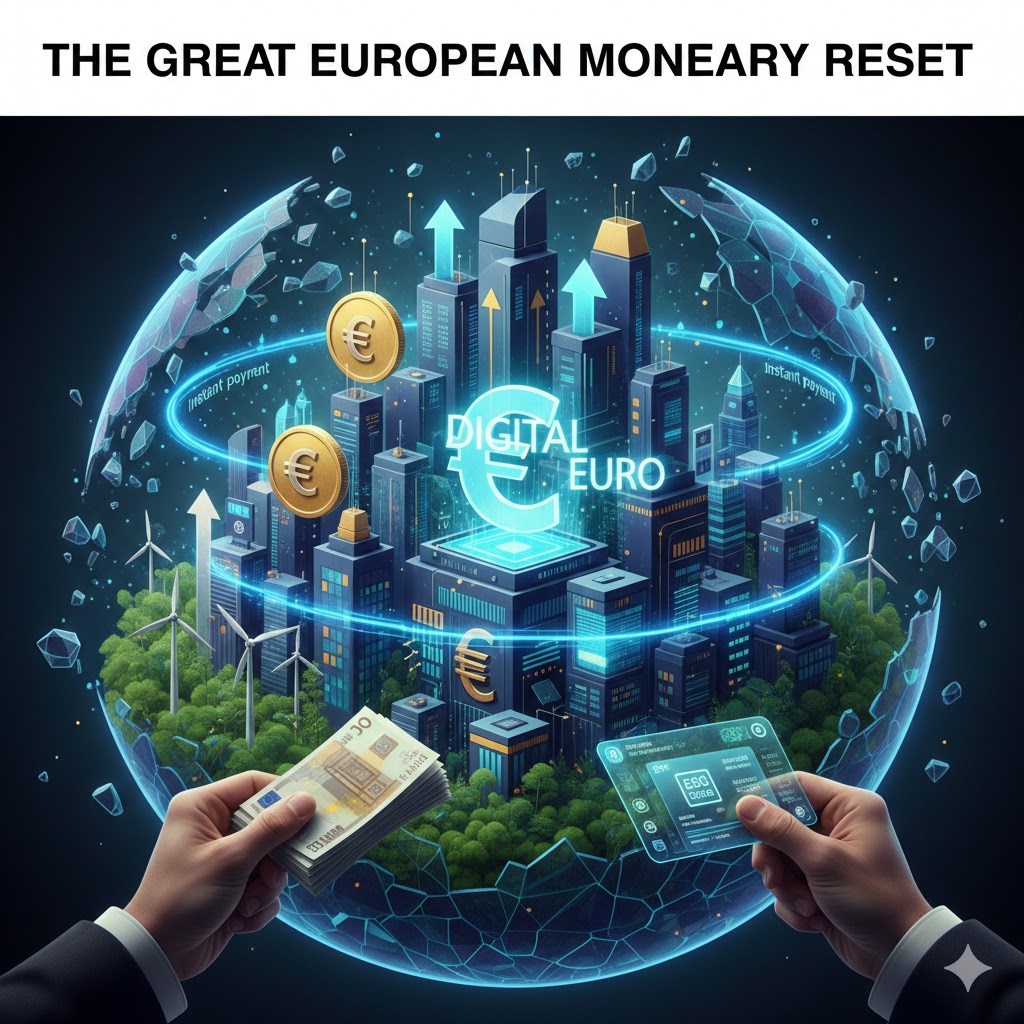
    The Great European Monetary Reset: Navigating the Future of Finance and the Digital Euro

    The European Union is at the precipice of its most profound financial transformation since the introduction of the euro banknotes and coins over two decades ago. This shift is not merely an upgrade; it is a fundamental re-engineering of the entire monetary and financial ecosystem, driven by a trifecta of forces: digitalization, regulation, and sustainability.

    For businesses, investors, and consumers alike, understanding this “Great European Monetary Reset” is paramount. The changes—from a central bank digital currency (CBDC) to instant payment mandates and radical sustainability disclosure rules—will redefine how we transact, invest, and manage wealth across the continent. This is the definitive guide to Europe’s future of money, a journey into the heart of modern finance and the policies shaping a digitally sovereign and green economy.


    I. The Digital Euro Revolution: CBDC as the New Monetary Anchor

    The most ambitious component of Europe’s financial future is the potential launch of the Digital Euro.
    This image shows the same euro coin in three different metals: silver, gold, and bronze. The coins are shown front-facing and are designed with the euro symbol on a plain surface, a grooved outer rim, and an inner border. While this coin set is a stylized representation, real euro coins are standardized in color and material.

    Shutterstock

    Explore

    This project by the European Central Bank (ECB) is not just a technological experiment; it is a defensive and strategic move to safeguard monetary sovereignty in an increasingly digital and geopolitically fragmented world.

    A. Why Europe Needs a Digital Euro

    The modern economy has largely shifted from physical cash to private digital money—deposits held at commercial banks or payments processed by a handful of global card schemes (like Visa and Mastercard). This shift creates two key vulnerabilities that the Digital Euro aims to address:

    1. Risk and Trust: Private commercial bank money carries a small, theoretical risk (which is mitigated by deposit insurance). Central bank money, however, is risk-free. As cash use declines, the public risks losing access to this risk-free form of money in the digital realm. The Digital Euro, as a CBDC, provides a safe, sovereign-backed anchor for digital payments.
    2. European Autonomy: The majority of non-cash payments in the Euro area rely on platforms and infrastructure originating outside the EU. This poses a threat to Europe’s financial stability and strategic autonomy. The Digital Euro is designed to be a pan-European payment solution, accessible and accepted in all euro area countries, fostering genuine competition and reducing reliance on international incumbents.

    B. Project Status and Key Timelines

    The Digital Euro project has moved through its exploration and investigation phases and is now firmly in the preparation phase. This phase, which includes the development of the technical foundations and the finalization of the Digital Euro Scheme Rulebook, is expected to be completed by the end of 2025.

    Crucial dates and milestones for the future include:

    • 2026: Expected adoption of the necessary EU legislation. This legislative backing is crucial, as it will determine the final design features, including privacy and limits on holdings.
    • Mid-2027: Potential start of a pilot exercise and initial transactions with payment service providers (PSPs).
    • 2029: The ECB aims to be ready for a potential first issuance.

    C. Design Principles: Privacy, Offline Functionality, and Limits

    The ECB has been clear that the Digital Euro must possess the benefits of cash in a digital form:

    • Privacy: The Digital Euro is designed to offer the highest privacy standards, particularly for low-value transactions. The ECB and the Eurosystem would not be able to identify users or track their payments, providing a significant privacy advantage over current commercial payment methods.
    • Offline Capability: To ensure continued availability, a key design feature is the ability to use the Digital Euro offline. This would allow payments to be made without an internet connection, strengthening resilience against outages and making it accessible to those with limited connectivity.
    • Financial Stability: To prevent mass shifts of funds from commercial bank deposits into Digital Euro holdings—a phenomenon known as bank disintermediation—the ECB will likely impose a limit on individual holdings. This limit would ensure the Digital Euro functions as a medium of exchange (for daily payments), not a vehicle for large-scale savings.

    The Digital Euro stands as Europe’s definitive commitment to having a future-proof, robust, and central bank-backed digital currency, fundamentally reshaping the definition of “money” for the 21st century.


    II. The Instant Payments Mandate: Redefining Real-Time Transaction Speed

    While the Digital Euro is a monetary innovation, the EU Instant Payments Regulation (IPR) is a market innovation that is transforming the daily operational flow of money right now. This regulation mandates that all payment service providers (PSPs) across the Euro area must offer real-time credit transfers—executed and settled within 10 seconds, 24 hours a day, 365 days a year.

    A. Key Obligations and The 2025 Deadline

    The IPR, which entered into force in April 2024, has strict, near-term deadlines for PSPs:

    • January 9, 2025: Euro-area PSPs must be able to receive instant payments.
    • October 9, 2025: Euro-area PSPs must be able to send instant payments.
    • Equal Charges: Charges for instant credit transfers cannot be higher than those for standard, non-instant transfers. This effectively makes instant payments the new standard at no extra cost to the consumer.

    B. Impact on Business and Financial Systems

    The mandatory nature of SEPA Instant Credit Transfer (SCT Inst) represents a massive change for the European economy:

    1. Working Capital Optimization: For businesses, particularly SMEs, the elimination of multi-day settlement cycles means immediate cash flow. This significantly reduces the working capital tied up in outstanding invoices, optimizing liquidity management and reducing reliance on short-term financing.
    2. Fraud Prevention (Verification of Payee): The regulation also mandates the Verification of Payee (VoP) service. This crucial anti-fraud measure requires PSPs to check if the beneficiary’s name matches the provided International Bank Account Number (IBAN) before the payment is sent. By alerting the payer to mismatches, VoP is a powerful tool against Authorized Push Payment (APP) fraud, a growing problem in real-time payment systems.
    3. The Rise of A2A Payments: The IPR is a massive accelerator for Account-to-Account (A2A) payments. By making transfers immediate and free (or cheaply priced), A2A payment solutions—often powered by Open Banking APIs—become a highly competitive alternative to traditional card networks for e-commerce and point-of-sale transactions.

    C. The European Payments Initiative (EPI)

    Complementary to the IPR, the European Payments Initiative (EPI) is a consortium of major European banks and payment providers aiming to create a unified, European-owned payment scheme. EPI is designing a digital wallet solution and an accompanying payment card to compete directly with US-based card giants, leveraging the new instant payment infrastructure. The goal is clear: to ensure that the future of digital money is settled on European rails.


    III. The New Regulatory Environment: MiCA, DORA, and Financial Resilience

    Europe’s push to modernize money is intrinsically linked to its ambitious regulatory agenda. The EU has become a global standard-setter in governing the digital economy, particularly in the nascent fields of crypto-assets and operational resilience.

    A. MiCA: Bringing Crypto-Assets into the Regulatory Fold

    The Markets in Crypto-Assets Regulation (MiCA) is a landmark piece of legislation that provides a single, harmonized regulatory framework for crypto-assets across all 27 EU member states. This clarity is a game-changer for the Fintech sector and the future of digital asset trading.

    • Stablecoin Regulation (June 2024): MiCA’s rules on Asset-Referenced Tokens (ARTs) and E-Money Tokens (EMTs) (colloquially known as stablecoins) are already in force. Issuers must be authorized, maintain full liquid asset backing, and comply with strict capital and reporting requirements, ensuring a level of stability and consumer protection previously absent in the sector.
    • Licensing and Service Providers (December 2024 – July 2026): By December 30, 2024, the full MiCA framework, including licensing requirements for Crypto-Asset Service Providers (CASPs), becomes applicable. CASPs—such as exchanges, custodians, and brokers—must obtain authorization from a national competent authority. This creates a passporting system, allowing a CASP licensed in one EU country to operate across the entire bloc.
    • Future Impact: MiCA is set to legitimize and formalize the use of crypto-assets, bolstering investor protection and attracting institutional finance to the European digital asset market. For businesses, this means regulatory certainty, which is essential for scaling blockchain-based and tokenization initiatives.

    B. DORA: Securing the Digital Financial Future

    The Digital Operational Resilience Act (DORA) addresses the flip side of digitalization: the risk of system-wide failure due to cyberattacks or IT disruptions. DORA creates a comprehensive set of rules to manage and mitigate ICT-related risks for financial entities, including banks, payment institutions, and even critical third-party ICT service providers (like cloud providers).

    • Key Focus: DORA mandates robust cyber risk management frameworks, stringent reporting of major ICT-related incidents, and rigorous digital operational resilience testing.
    • Future Reference: DORA’s implementation underscores the EU’s recognition that the future of finance is utterly dependent on the stability and security of its underlying digital infrastructure. It represents a proactive regulatory step to ensure the resilience of the system that hosts the Digital Euro and Instant Payments.

    IV. The Greening of Capital: Sustainable Finance and ESG Investing

    The flow of future money in Europe is being steered not just by technology, but by a legally binding commitment to environmental and social objectives. Europe has established itself as the global leader in sustainable finance, channeling capital toward the green transition to meet its Net-Zero goals.

    A. The Sustainable Finance Disclosure Regulation (SFDR) Overhaul

    The Sustainable Finance Disclosure Regulation (SFDR) has been the EU’s primary tool for driving transparency in the ESG investing market. However, in late 2025, the European Commission proposed significant amendments (sometimes referred to as SFDR 2.0) to address market confusion and combat greenwashing.

    • The Problem: The existing SFDR disclosure requirements were complex and were being used as a de facto labelling system (with “Article 8” and “Article 9” funds), leading to confusion, particularly among retail investors.
    • The Future System (SFDR 2.0): The overhaul aims to simplify the framework by introducing a new, clear, voluntary categorization system, replacing the vague disclosure tiers:
      1. Sustainable Products: For products pursuing a clear, high-ambition environmental or social objective.
      2. Transition Products: A crucial new category for products financing companies that are not yet fully sustainable but have credible transition plans to achieve alignment with climate goals (e.g., the Paris Agreement). This will help unlock capital for the heavy-polluting sectors that most need to decarbonize.
    • Impact on Investment: This structural change is designed to make the sustainability of investment products clearer, simpler, and more verifiable. By deleting complex entity-level disclosures and simplifying consumer-facing templates, the EU is making it easier for retail investors to align their savings with their values, accelerating the flow of capital toward green bonds, impact investing, and other sustainable assets.

    B. The EU Taxonomy and Corporate Reporting

    The EU Taxonomy—a classification system for environmentally sustainable economic activities—remains the gold standard for defining what constitutes a “green” investment. When paired with the Corporate Sustainability Reporting Directive (CSRD), which mandates detailed, standardized ESG reporting from thousands of large companies, the EU is building an interconnected data highway.

    This combination of rules ensures that the money flowing through the European financial system—from the retail investor’s mutual fund to the commercial bank’s corporate loan—is increasingly transparently and verifiably linked to sustainable outcomes. This shift is not a niche market; it is the mandatory future of European finance.


    V. The Quest for Deeper Markets: Capital Markets Union (CMU)

    Beyond payments and regulation, Europe’s future prosperity hinges on transforming how savings are used to fund the economy. This is the core mission of the renewed Capital Markets Union (CMU) project.

    A. The “Money-Under-the-Mattress” Challenge

    European households have historically been cautious savers, keeping a disproportionately large share of their wealth in low-return, high-safety bank deposits. While safe, this money is often unproductive for the economy, failing to provide the long-term, risk-bearing capital needed for ambitious, innovative companies—the engine of future growth.

    B. Objectives of the CMU

    The CMU aims to break down the persistent barriers between national capital markets to create a truly single market for investment and savings. Key objectives include:

    • Mobilizing Retail Investment: Implementing policies and platforms to make it easier, safer, and cheaper for the average European to invest in stocks, bonds, and investment funds across the EU. The simplification of SFDR disclosures (Section IV) is one step in this direction.
    • Boosting Venture Capital and Growth Equity: Creating pan-European legal structures and easing regulatory burdens to attract more investment into European start-ups and scale-ups, especially in critical sectors like deep tech, AI, and green technology.
    • Harmonizing Insolvency Laws: Simplifying cross-border insolvency procedures to make it less risky for investors to fund companies operating across multiple EU jurisdictions.

    C. Future of Wealth Management

    If the CMU succeeds, the future of wealth management in Europe will look drastically different: European capital markets will be deeper, more liquid, and more attractive than ever before. This will lead to a fundamental shift in the wealth portfolio of the average European, with a greater allocation to risk capital that can, in turn, accelerate the continent’s economic transformation.


    VI. The Hybrid Future: Cash’s Enduring Role and Digital Inclusion

    Despite the seismic digital shifts, the future of money in Europe is hybrid. While instant payments and the Digital Euro will dominate the digital landscape, physical cash is not disappearing entirely.

    A. The Political and Social Value of Cash

    In countries like Germany and Austria, cash remains highly valued for its privacy and sense of financial freedom. The European Commission and national governments recognize that cash is essential for:

    1. Inclusivity: Providing a reliable payment method for the unbanked, the elderly, and those with limited digital literacy.
    2. Resilience: Serving as a fallback mechanism during power outages, cyberattacks, or widespread technical failures.
    3. Privacy: Offering a fully anonymous payment option that is fundamentally risk-free.

    B. Safeguarding Cash Access

    To counter the market forces leading to the withdrawal of cash services (e.g., banks closing branches and ATMs), the EU is considering or implementing legislation to ensure that cash remains widely accepted and accessible. This means the future will see policy interventions to guarantee a minimum level of cash infrastructure alongside the rollout of the Digital Euro.

    The vision is one of choice: a Digital Euro for the convenience and speed of the digital world, and physical cash for privacy and resilience.


    VII. Conclusion: Europe’s Strategic Path to Digital Sovereignty and Green Capital

    Europe is not passively observing the global evolution of money; it is actively legislating its future. The coming years will see a synchronized launch of the Digital Euro (the new monetary anchor), the ubiquitous availability of Instant Payments (the new payment standard), and the full operationalization of MiCA and SFDR 2.0 (the definitive regulatory framework).

    This ambitious, coordinated effort has three core strategic goals:

    1. Digital Sovereignty: Securing European control over its own payment infrastructure and digital currency.
    2. Financial Resilience: Using DORA and the Digital Euro’s offline features to bulletproof the system against disruption.
    3. Green Transition: Using the power of regulation (SFDR, Taxonomy, CSRD) to force transparency and reallocate billions in private capital toward sustainable economic activity.

    For individuals, the future means faster, safer, and potentially more private digital payments. For financial institutions and businesses, it means massive, costly, but ultimately mandatory digital and compliance overhauls. For the global economy, it means a European model where finance is increasingly accountable for both its technological reliability and its ecological impact. The time to prepare for this profound monetary reset is now. The future of European money is here, and it is digital, instant, and green.

  • The 2026 World Cup: A $30.5 Billion Economic Analysis and the Global Financial Playbook for the US Region

    The 2026 World Cup: A $30.5 Billion Economic Analysis and the Global Financial Playbook for the US Region

    The 2026 FIFA World Cup, hosted across North America, is not merely a sporting fixture; it is a seismic event in global sports finance. With an unprecedented scale of 48 teams and 104 matches, the United States, hosting the vast majority of the tournament across 11 major cities, stands to be the primary beneficiary of a massive, concentrated economic shock. This analysis delves into the projected $30.5 billion economic impact, exploring the mechanisms of job creation, sectoral booms, and critical financial headwinds that will define this colossal undertaking.

    I. The Macroeconomic Engine: Quantifying the $30.5 Billion Gross Output

    The official economic forecasts position the 2026 World Cup as one of the largest short-term economic stimuli in recent U.S. history. Analysts project the tournament to generate an estimated $30.5 billion in gross output and contribute approximately $17.2 billion in Gross Domestic Product (GDP) within the United States. These figures are driven by the scale and duration of the event, necessitating a deep dive into the underlying economic concepts that translate fan enthusiasm into fiscal reality.

    The Dynamics of Economic Impact Analysis

    The total projected impact is dissected using an established methodology that considers three core components: Direct, Indirect, and Induced effects—collectively known as the economic multiplier.

    A. Direct Economic Impact: The Immediate Influx of Capital

    The Direct Impact is the immediate financial injection attributable to the event. This includes spending by:

    • International Visitors: Over one million foreign tourists are expected, each staying for an average of 12 days and spending approximately $416 daily on discretionary items alone. This spending covers high-ticket items like official merchandise, fan zone access, dining, and local attraction entry.
    • Event Organizers and Sponsors: Expenditure on venue rentals, technology infrastructure (e.g., dedicated 5G networks), security contracts, and temporary personnel wages.
    • Tourism Expenditure: A significant portion of the total economic output is tied directly to these initial transactional waves—the purchase of airfare, accommodation, and match tickets.

    B. Indirect and Induced Impacts: Amplifying the Financial Ripple

    The multiplier effect ensures that the economic benefit ripples beyond the immediate point of sale.

    • Indirect Impact (Supply Chain): This component tracks the business-to-business (B2B) activity spurred by the Direct Impact. For instance, the surge in demand at hotels and restaurants in Houston or Kansas City mandates increased bulk purchasing of supplies—linens, fresh produce, cleaning chemicals—from regional distributors and suppliers. This upstream expenditure generates revenue for secondary industries like logistics, wholesale, and local manufacturing.
    • Induced Impact (Wage Recirculation): This final, crucial layer of the multiplier is the economic activity created when the new or overtime wages earned by employees (in the direct and indirect sectors) are spent within the local economy. An extended-hours retail worker in Atlanta, for example, uses their increased earnings for local consumption, boosting tertiary sectors like personal services or durable goods sales. This recirculation provides the final thrust toward the $30.5 billion gross output projection.

    II. Sectoral Deep Dive: Where the Money Moves

    The concentrated spending power of millions of fans creates extreme demand spikes in highly localized economies, fundamentally altering the short-term financial outlook for key U.S. sectors.

    A. The Hospitality Sector: ADR and RevPAR Surges

    The accommodation sector, spanning hotels, motels, and short-term rentals (Airbnb, Vrbo), is the clearest and most immediate financial beneficiary.

    • Pricing Power: Host cities are already exhibiting exceptional pricing power. Average Daily Rates (ADR) across the 11 U.S. cities have seen a preliminary surge of over 55% year-over-year. In prime gateway cities like New York/New Jersey, ADRs are projected to command premiums nearing $583 per night during match windows. This intense demand drives a substantial lodging lift, with incremental hotel room revenues expected to rise between 7% and 25% during the tournament months, significantly boosting Revenue Per Available Room (RevPAR) metrics.
    • Tax Revenue Windfall: The Transient Occupancy Tax (TOT), or hotel tax, is a primary source of municipal revenue during the World Cup. In a high-profile host like Los Angeles County, the event is projected to yield approximately $34.9 million in local tax revenue, with nearly two-thirds of that sum coming directly from the TOT, demonstrating the fiscal importance of maximizing occupancy and high ADRs. The tournament is projected to deliver over 330,000 incremental room nights above the baseline.

    B. Retail, Food & Beverage, and Local Services

    The cultural and social components of the tournament fuel localized consumer spending.

    • F&B Overload: Restaurants, bars, and catering services operating near stadium perimeters and official fan festivals will experience their peak financial quarter. The demand for Food & Beverage (F&B) is inelastic during the tournament, providing businesses with enhanced profitability opportunities.
    • Retail Consumption: While a large portion of spending goes to official merchandise, local retail outlets also benefit significantly. Tourists seek out regional souvenirs, and the demand for comfort items, apparel, and electronics sees a boost, feeding directly into state sales tax collections.
    • Employment Boom: The need for rapid service scaling drives the creation of an estimated 185,000 Full-Time Equivalent (FTE) jobs across the U.S. The bulk of these are temporary, low-wage positions in the service and hospitality industries, yet they represent a massive injection of increased wages (projected to be over a quarter of a billion dollars in Southern California alone), which feeds the Induced Impact.

    III. The Logistical and Financial Headwinds: Managing Risk and Currency Volatility

    Despite the optimistic projections, the ultimate economic realized benefit is contingent upon navigating several significant financial and geopolitical headwinds—the “catch” that tempers the headline $30.5 billion figure.

    A. Visa Constraints and Tourism Displacement

    The greatest threat to the projected international visitor numbers is non-economic: the regulatory environment for inbound travel.

    • Restrictive Policies: Concerns surrounding lengthy U.S. visa processing times and a perceived political climate of tighter border scrutiny can deter high-volume fan groups from key markets (e.g., China, India, Brazil).
    • The Visa Integrity Fee: The introduction of a $250 “visa integrity fee” for non-Visa Waiver countries adds a direct, non-negotiable cost to international travel budgets. This fee, coupled with already high airfare and lodging costs, threatens to push potential travelers toward co-hosts Canada and Mexico, where entry requirements may be less stringent or costs lower, resulting in tourism displacement away from U.S. host cities.
    • Mitigation Strategy: Host city tourism boards must engage in targeted marketing towards strong, secure inbound regional markets (Canada, Mexico, U.K.) to ensure robust attendance, focusing on the domestic and North American fan base to stabilize overall demand and occupancy rates.

    B. The Strong U.S. Dollar and Foreign Exchange (FX) Risk

    For international visitors, the foreign exchange rate is the single most critical factor determining the affordability and total cost of their trip.

    • The Affordability Crisis: When the U.S. Dollar (USD) is strong against other major currencies, such as the Euro (€), the Brazilian Real (R$), or the Japanese Yen (¥), every expenditure in the U.S. becomes exponentially more expensive for the international fan. A 5% appreciation of the USD can instantly wipe out hundreds of dollars from a fan’s travel budget, potentially leading to fans choosing shorter stays or trading down to cheaper accommodations.
    • Impact on Discretionary Spending: High currency conversion costs directly reduce the amount of discretionary spending a traveler can afford. A fan who budgets $5,000 might find their purchasing power reduced to the equivalent of $4,500 due to unfavorable FX rates and fees, shrinking the ultimate injection into the retail and F&B sectors.

    Critical Tool Integration: The Need for a Real-Time Exchange Rate Tool

    For all international fans, investors, and businesses involved in the 2026 World Cup, the ability to monitor and manage currency volatility is essential for accurate financial planning.

    To best serve our readers and the global fan community, we highly recommend using a dedicated, real-time exchange rate tool. This tool should provide instant, up-to-the-minute conversions for the latest exchange rate between USD and all major global currencies. This capability is vital for:

    1. Travelers: Accurately calculating the true cost of hotel reservations, ticket purchases, and daily expense budgets in their home currency, mitigating unexpected financial stress.
    2. Businesses: Hedging against currency risk when dealing with international sponsorship contracts and pre-bookings, and setting flexible pricing strategies that remain competitive despite currency fluctuations.

    C. Pricing Strategy and Demand Uncertainty

    The risk of aggressive pricing (high ADRs) leading to low early-stage occupancy is a major concern.

    • Occupancy Risk: Early data suggests hotel occupancy remains low for tournament dates as fans await finalized match schedules. If hotels refuse to employ dynamic pricing strategies and insist on maximum rates, they risk high vacancy rates if ticket draws do not align with fan travel plans.
    • Flexibility: The hospitality sector is advised to use data-driven decision-making to offer flexible booking and cancellation policies alongside dynamic rates to attract bookings from regional and international visitors as ticket draws materialize, securing the crucial incremental room revenues.

    IV. The Lasting Legacy: Infrastructure, Branding, and Soft Power

    The ultimate ROI of hosting the World Cup is determined by the long-term, structural benefits that accrue long after the final whistle blows.

    A. Capital Expenditure and Infrastructure Legacy

    The United States holds a unique advantage: nearly all host cities benefit from a low capital expenditure (CapEx) environment due to the reuse of modern, large-capacity NFL and MLS stadiums.

    • Low “White Elephant” Risk: Unlike previous host nations that invested billions in purpose-built stadiums that later become underutilized “white elephants,” the U.S. investment is concentrated on “overlay” infrastructure (technology, temporary security, media facilities) and crucial mobility upgrades for public transport (e.g., enhanced metro access, new bus routes).
    • Sustainable Development: These targeted urban renewal projects enhance the long-term utility of city infrastructure, providing a lasting benefit to residents and strengthening the city’s capacity to host future large-scale events, securing the sustainable tourism future of the host regions.

    B. Intangible Assets: Global Exposure and City Branding

    The World Cup is an unparalleled generator of intangible assets and soft power.

    • Media Value: The billions of dollars in free global media exposure showcase the U.S. host cities—from the energy of Miami to the corporate power of Dallas—to the world. This exposure is invaluable for city branding, promoting the U.S. as a world-class tourism, investment, and sporting destination.
    • Sporting and Social Legacy: The tournament will accelerate the growth of soccer interest, fan attendance, and commercialization of the MLS, providing a substantial sporting legacy. Furthermore, the estimated $8.28 billion in social benefits includes the boost to civic morale, community cohesion, and youth sports development across the nation.

    V. Final Score: A Balanced Outlook for the North American Economic Tournament

    The 2026 FIFA World Cup represents a definitive moment for the U.S. economy, promising a significant economic catalyst through a projected $30.5 billion gross output and the creation of 185,000 FTE jobs. The financial boom will be most acutely felt in the hospitality, retail, and transportation sectors, particularly in the 11 host cities, which will benefit immensely from increased tax revenues and a dramatic surge in ADR and RevPAR.

    However, the final, realized net economic benefit will hinge on the successful mitigation of critical financial headwinds. The combination of the strong U.S. dollar, high price points, and geopolitical barriers threatens to suppress international demand.

    To ensure the maximum economic realization of this global spectacle, policymakers, investors, and local businesses must focus on flexible pricing, targeted marketing, and providing fans with the necessary tools for financial literacy and accurate budgeting, such as a real-time currency converter. By managing these risks strategically, the United States is poised not only to host a record-breaking sporting event but to secure a lasting, positive financial legacy for the decade to come.

  • The European Financial Reset: Your Definitive 2026 Playbook for Wealth Resilience and Growth

    The European Financial Reset: Your Definitive 2026 Playbook for Wealth Resilience and Growth

    Introduction: Navigating the New Stability in European Finance

    Welcome to the definitive guide to financial planning in Europe for 2026. After a turbulent period dominated by high inflation risk and aggressive interest rate hikes from the European Central Bank (ECB), the European financial landscape is entering a phase of measured stability. However, this stability is underpinned by complex, evolving challenges, including geopolitical fragmentation, the escalating demands of digital and energy transition investment opportunities, and new EU financial regulation impact.

    For the proactive investor and budgeter, 2026 is not a time to relax, but a time to execute a surgical financial strategy. The goal is to move beyond simply fighting inflation to actively building wealth resilience and capitalizing on the structural shifts defining the continent. This comprehensive playbook offers personal finance tips europe needs right now, focusing on the tactical deployment of capital in savings, investments, and debt management to ensure your financial status in control.

    The focus of smart financial planning Europe 2026 is on Expertise, Authoritativeness, and Trust (E-E-A-T), particularly in the complex, regulated financial services sector. Our guidance leverages insights into expected monetary policy shifts, key European sovereign debt risk metrics, and the accelerating integration of AI into both market structure and daily personal finance tips europe users rely on.

    Section 1: The Macroeconomic Bedrock – What Drives European Finance in 2026?

    Understanding the operating environment is the first step toward successful best investment strategies 2026. The 2026 forecast points to three dominant themes:

    1.1 The ECB and Rate Normalization

    The ECB is expected to continue its data-dependent approach. While headline inflation is projected to settle near the $2\%$ target, stubborn wage growth and strong demand in the services sector mean that the path to rate cuts will be slow and cautious.

    • Key Takeaway: The era of near-zero rates is definitively over. This is a foundational shift affecting everything from mortgage costs to the profitability of high-yield savings accounts europe. Money now has a real cost, and that cost must be factored into every decision, from large purchases to business expansion.

    1.2 Geopolitical Fragmentation and Resilience

    Global trade is reorienting. The drive for security, resilience, and sovereignty—particularly in energy, defense, and digital infrastructure—is overriding the pure pursuit of efficiency. This “fragmentation” trend is directly impacting capital flows and creating high-growth sectors.

    • Impact on Investing: This shift fuels massive investment opportunities in areas like digital infrastructure investing (data centers, fiber networks) and energy transition investment opportunities (renewables, grid upgrades). These are not cyclical trends; they are structural shifts supported by multi-year EU and national funding initiatives.

    1.3 The Shadow of Sovereign Debt

    The sheer scale of public debt accumulated across the Eurozone—driven by pandemic relief, energy subsidies, and increased defense spending—is a significant European sovereign debt risk. Markets are increasingly sensitive to the fiscal health of individual member states.

    • Action for Investors: This risk demands a higher degree of caution concerning bond allocations. Diversification is non-negotiable, and investors must be selective, seeking out assets that provide a hedge against potential fiscal instability, such as gold, highly-rated corporate bonds, or high-quality real assets.

    Section 2: Optimizing Your Cash & Liquidity – A Strategic Approach to Savings

    The most immediate and controllable area of your financial health is liquidity. A well-structured liquidity strategy is the bedrock of financial planning europe 2026.

    2.1 The New Importance of High-Yield Savings Accounts

    With interest rates normalized, cash holdings are no longer a guaranteed loser. High-yield savings accounts europe and short-term term deposits (fixed-rate bonds) are crucial tools.

    • Strategy: Your emergency fund (3-6 months of expenses) should be actively managed in a HYSA. Crucially, look beyond your immediate national bank, as cross-border EU savings platforms may offer better rates due to lower overheads and stronger competition.
    • Target Keyword: best high-yield savings account rates europe, compare fixed-rate savings accounts EU, short-term investment for emergency fund.
    • The Liquidity Ladder: For cash beyond the emergency fund (e.g., a down payment in 18 months), consider a “liquidity ladder” using fixed deposits of varying maturities (e.g., 6, 12, and 18 months). This strategy optimizes returns while ensuring staggered access to your capital.

    2.2 Re-evaluating Debt Management

    The core principle of managing inflation risk has always been to prioritize high-interest debt. This remains true in 2026.

    • Consumer Debt: Aggressively eliminate high-cost, non-collateralized debt like credit cards and personal loans. The interest rates on this debt far outpace potential returns from even the best investment strategies 2026.
    • Mortgage Strategy: For homeowners with variable-rate mortgages, 2026 could be a crucial year. If you value certainty, explore options to fix the rate, even if it’s at a slightly higher initial cost than the variable rate, as protection against unexpected rate hikes driven by renewed inflation risk. For those with long-term, low-rate fixed mortgages, leverage the interest differential by investing the difference rather than aggressively paying down the principal.
    • Target Keyword: how to pay off high-interest debt in europe, fixed vs variable mortgage rate europe 2026, debt consolidation strategies EU.

    Section 3: The Investment Playbook – Best Investment Strategies 2026

    The investment landscape for 2026 rewards investors who seek quality, resilience, and alignment with the long-term structural trends of the European economy. Diversification strategies 2026 must be your guide.

    3.1 Capitalizing on Europe’s Structural Growth Trends

    The future of European investment is not in consumer staples, but in the enabling technologies of the future.

    • The AI and Digital Backbone: The necessity of digital infrastructure investing—data centers, 5G networks, and high-speed fiber—is non-negotiable for future productivity. Look for ETFs or funds specializing in European Digital Infrastructure.
    • The Green Transition: The push for net-zero remains a core pillar of EU policy. Energy transition investment opportunities are vast, covering everything from smart grid technology and battery storage to renewable energy producers and green hydrogen technology. These investments benefit from strong long-term regulatory support and massive public capital injection.
    • Target Keyword: investing in european green deal companies, best AI stocks europe 2026, infrastructure funds Europe.

    3.2 Global Diversification and The Risk of Concentration

    The concentration of market gains in a few US-based technology giants poses a global risk. Smart diversification strategies 2026 must explicitly address this.

    • Go Global, Selectively: While the US market remains dominant, seek balance. Increase exposure to high-quality European blue-chip companies (often cheaper than US peers) and resilient sectors in emerging markets that supply critical resources to the EU (e.g., metals, specific manufacturing).
    • The Role of Private Markets: Private equity for individuals europe is becoming more accessible. New EU regulations, such as the ELTIF (European Long-Term Investment Fund) 2.0, are lowering the barriers for retail investors to participate in private markets. These assets can provide portfolio diversification and access to the high-growth, early-stage European companies not available on public exchanges.
    • Target Keyword: private equity for individuals europe ELTIF, global investment diversification strategies, asset allocation strategies 2026.

    3.3 Mastering the Fixed Income Market

    With bond yields normalized, fixed income is back as a true portfolio asset, not just a holding pen for cash.

    • Focus on Credit Quality: Given the ongoing European sovereign debt risk, favor high-quality corporate and sovereign bonds with strong credit ratings. Avoid chasing yield in the riskiest, lower-rated segments.
    • Duration Management: A “barbell” strategy—holding both very short-term bonds (for liquidity) and very long-term bonds (to lock in current yields and hedge against a potential recession)—can be effective. Mid-duration bonds offer less clear value in this phase of the cycle.
    • Target Keyword: best corporate bond ETFs europe 2026, fixed income strategy for rising interest rates.

    Section 4: Retirement and Legacy Planning – Long-Term European Financial Security

    No discussion of financial planning europe 2026 is complete without addressing retirement planning europe and tax efficiency.

    4.1 The Imperative of Supplementary Pensions

    Public pension systems across Europe are under mounting demographic pressure. Relying solely on the state pension is a major long-term risk.

    • The Three Pillars: Every European should optimize contributions to all available pension pillars:
      1. State Pension: Understand your projected benefits.
      2. Occupational Pension: Maximize employer matching contributions—this is often “free money.”
      3. Personal Pension: Actively use national or pan-European tax-advantaged private pension schemes. The Pan-European Personal Pension Product (PEPP) is designed to offer a simple, transparent, and portable option across the EU.
    • Target Keyword: best private pension plans europe, PEPP pension scheme explained, retirement planning europe calculator.

    4.2 Navigating Tax-Efficient Investing Europe

    Tax efficiency is crucial for compounding returns. The rules vary dramatically by member state, making localized advice essential, but a few pan-European principles apply:

    • Capital Gains vs. Income: Focus on holding growth assets (equities) within tax-sheltered accounts (pensions, ISAs/their equivalents) where capital gains are taxed lightly or deferred.
    • Dividend Tax: Be mindful of withholding taxes on dividends, especially from non-EU stocks, and understand how your national tax treaty allows you to reclaim or credit them.
    • Expats and Cross-Border Workers: Expat financial planning europe is complex. The shift in tax residency, social security (S1 forms), and the differing treatment of foreign investment wrappers require specialist advice. Always ensure compliance with the tax laws of both your current residence and your home country.
    • Target Keyword: tax-efficient investing europe guide, expat financial planning europe tax advice, capital gains tax eu member states.

    Section 5: The Digital Revolution in Personal Finance – AI and the Advisor

    The acceleration of Artificial Intelligence is the biggest structural shift in the finance industry. This is the new frontier for personal finance tips europe.

    5.1 AI in Finance Impact on Decision Making

    AI is moving from a back-office tool to a consumer-facing utility. By 2026, many Europeans will use AI-powered interfaces for:

    • Personalized Budgeting: Predictive UX will anticipate your cash flow, flagging potential shortfalls before they occur.
    • Compliance and Security: AI will enhance fraud detection and simplify the navigation of complex EU financial regulation impact by providing real-time, context-aware information.
    • Opportunity: Embrace these tools. Use AI-driven apps to track spending, categorize expenses, and monitor savings goals. Data-driven budgeting is easier and more precise than ever.
    • Target Keyword: AI in finance impact on personal budgeting, fintech apps for european investors 2026, best budget tracking apps europe.

    5.2 Financial Advisor vs Financial Planner: Choosing Human Expertise

    The rise of AI has clarified the role of the human advisor. Basic informational queries and transactional tasks are automated, but complex, relationship-driven advice remains the domain of the professional.

    • Financial Advisor vs Financial Planner: Understand the distinction. An financial advisor vs financial planner is crucial:
      • Advisor (Sales Focus): Often compensated by commission, selling specific products.
      • Planner (Holistic Focus): Fee-based or fee-only, offering comprehensive, unbiased advice on all aspects of your financial life (tax, retirement, estate, insurance).
    • EEAT and Trust: Due to the “Your Money or Your Life” (YMYL) nature of finance, Google and users demand maximum credibility. Choose planners who demonstrate clear credentials, transparent fee structures, and regulatory compliance.
    • Target Keyword: financial advisor vs financial planner fee structure, how to choose a financial planner in europe, fiduciary duty financial planner europe.

    Section 6: Practical Implementation and Next Steps

    Successful financial planning europe 2026 is about consistency, not complexity. Follow this quarterly cycle:

    QuarterFocus AreaAction Steps
    Q1: The ReviewDebt & LiquidityConsolidate high-interest debt. Review the APY on all high-yield savings accounts europe. Maximize tax-advantaged retirement contributions (Pillar 3).
    Q2: The AuditInvestments & DiversificationRebalance your investment portfolio. Review sector allocations, ensuring alignment with structural growth (e.g., energy transition investment opportunities). Check for concentration risk.
    Q3: The EducationTax & KnowledgeConsult a specialist for tax-efficient investing europe tips, especially if you have cross-border income or assets. Learn about new EU financial regulation impact on consumer banking.
    Q4: The ForecastPlanning & BudgetingCreate next year’s budget. Stress-test your budget against a potential rise in European sovereign debt risk (i.e., a sudden recession). Review insurance coverage (life, income protection).

    The key to long-term financial health in 2026 is merging technology-driven efficiency with human expertise. Stay informed, remain diversified, and prioritize the structural growth drivers of the European economy.